Tirana’s Pyramid was opened in 1988, built in memory of Albania’s dictator Enver Hoxha to be a museum of his life. It once told me, ‘MOS ME HARRONI’ / ‘DO NOT FORGET ME’. These words were scrawled in paint onto its pale marble façade as a plea for survival. The Pyramid stayed and was renovated, but some of its magic was diminished in the process. Yet its plea remains in my head today as I walk through the streets of the oldest part of the city, lying to the east of the modern day centre. The many derelict Ottoman and early twentieth century villas seem to be saying the same thing, urging passers by not to forget them, not to leave them to ruin, not to pour concrete into their bowels.

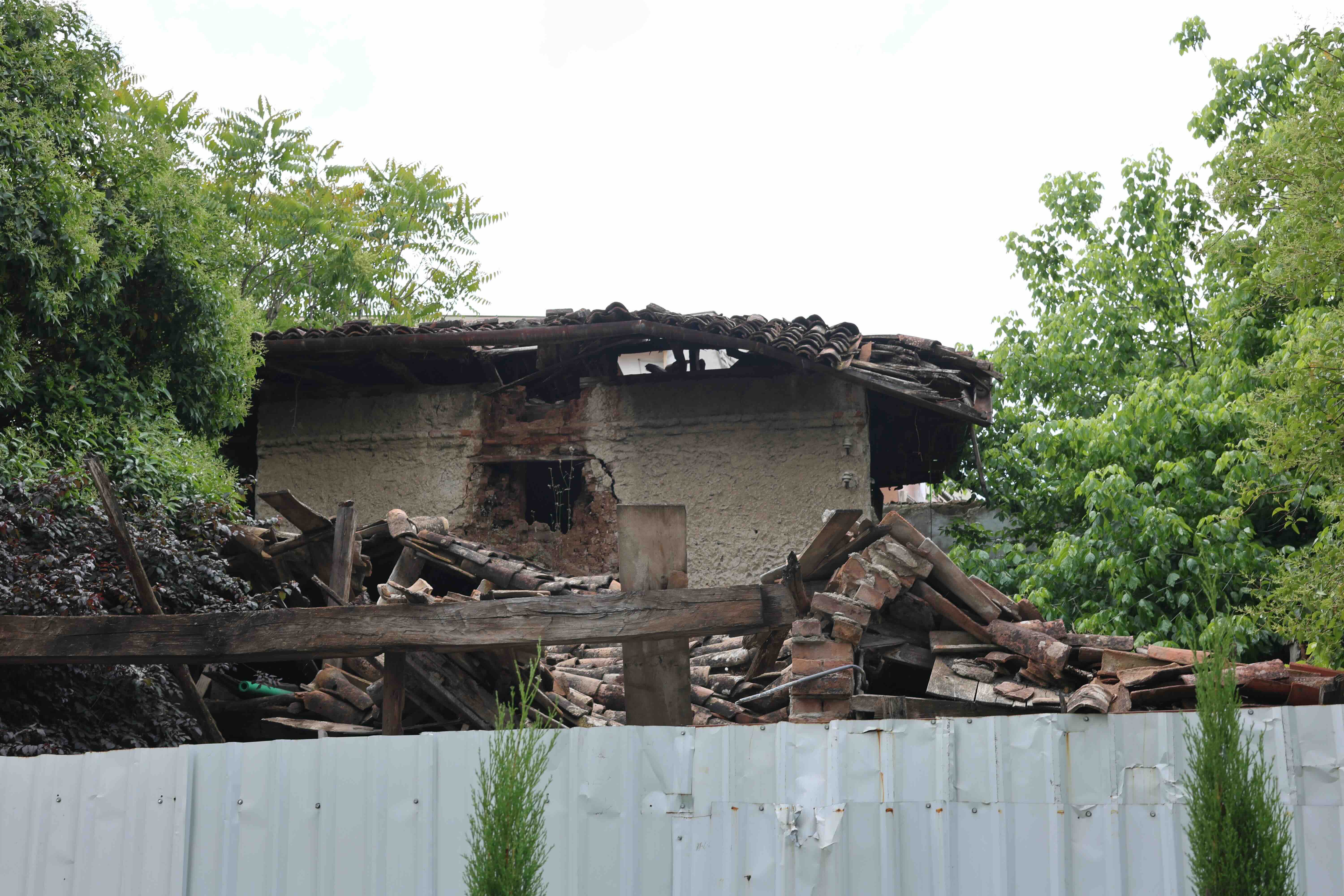
Beyond grey metal hoardings the roof has blown off an Ottoman villa. Its insides are on the outside. Clay tiles still attached and overlayed onto one another have been grounded. Timber, hundreds of years old, is exposed to the elements. Water and weeds fill up a living room. Plaster cracks and falls to the ground, peeled from its inner skin. Wooden shutters hang from a metal thread and the decay just spreads. Gravity pulling it to earth.
Tirana is a place that can give a lifelong citizen a case of homesickness. Its heady, speedy development has made it unfamiliar. A space where children once played has been subsumed by a postmodern tower, the park where I used to sit awkwardly next to men playing dominoes has hoardings all around it. These sites are victims of Tirana’s upward construction boom. The site of an old villa that held the ghosts of past lives, says, ‘luxury living coming here soon’. The gloss of a dream that few can touch.
A staggering amount of old Tirana villas have been lost in the city’s building boom, some of these were listed historic monuments. These villas may have fallen into disrepair due to unclear ownership post-communism, or perhaps the owners have moved to another country. Often the family who owns the villa may agree to the redevelopment in order to receive apartments in the new block. There are spaces that are trying to resist, trying to restrain the upward movement of the city, but these are always interrupted. The noise of a pigeon cooing in an ancient courtyard is layered with that of a mechanical crane moving across the sky, up and down, right and left and up and down again. Turning every so often. The long arm of progress.


I have written previously about the need for Albania to build from its roots. To support and value the home grown, and build its towns and cities upon these values and this history. Yet Tirana has now become an international stararchitect’s playground. Tirana’s new towers display a weird kind of kitsch nationalism. The generically named ‘Downtown One’ has cantilevered structures on its façade which form an odd, pixilated map of Albania. Another building is clad in the red and black colours of Albania’s flag, whilst the form of another has the profile of Skanderbeg, Albania’s national hero. It sounds funny, but it’s embarrassing. They are the kind of ideas that you might have after a few pints down the pub, what architecture critic Oliver Wainwright has called “cartoonish creations that seem to have been plucked from the depths of a joke shop bargain bin”. He’s not wrong in this assessment. But beyond the architecture, the apartments that are being built go no way to attending to the real housing problems facing Albania. The increasingly high costs of buying and renting, the poor and cramped living conditions of many people who live on the periphery and the quality of the surrounding environment. Instead these apartments do nothing but end up in investment portfolios, like many new apartments being built speculatively (and sometimes as objects through which to launder money) in major cities around the world. At night the lights in these buildings are off. No-one’s home.


Every piece of land flattened and every piece of soil unwillingly gouged out the ground tells us not to forget it. Memory and storytelling is a powerful thing. It says, “things didn’t used to be this way; things don’t need to be this way”. Remember the way the dalias used to flower, envision the clotted cream jasmine which once grew over the wall, see the swallows zipping from here to there. The cherry trees were heavy with fruit, the fruit dropped down onto the cobblestones and were squashed underfoot. Remember opening the shutters before our evening walk when the sun was ready to be let back into the house. Feel the warmth. Feel the warmth.
Out on the boulevard a tourist tour goes past. The guide tells the group in English, “Look, here there will be a brand new theatre!” and the tourists murmur approvingly. I turn to tell them the real story of how the historic twin theatre buildings were demolished against the will of the city’s citizens, at 4am on the last day of a lockdown, but they have already gone. If the truth isn’t told then the narrative is smoothed by the government and the media. The only story being told is that about upward progress and economic development. Not the exploitation of the land which is dug and dredged and filled with concrete, not the housing pains felt by many of the population, and not the vast amounts of money being laundered that return nothing to the local population.


Resistance lies in not forgetting. In never forgetting. Resistance lies in staying with the pain. This resistance emerges in the work of researchers and journalists who have been mapping the historical and cultural value of the lost villas and what has been built in their place[1]. It enables us to see the city as it once was. To keep walking the streets imagining and remembering where the river once flowed, where the children played, where the tracks and paths were laid by feet upon feet upon feet. To hear the voices of the domino players and feel the cool shade of grape vines hanging above. To remember the party in the yard as the dusk was growing and glowing around. The men dancing and jumping with knees high to the Vallee e Kukesi. Raki flowing through mouths and down throats, warming bellies and heads. This is the mind’s eye that will be the resistance. This requires being attuned to the way things were, to being able to read the city simultaneously through the lens of now and before, and to map what the city used to be.
Underneath the International Hotel there lies the trace of a home ripped out by the Communists. The breath of its people are still there. The stories still exist but they must be told and retold and told again down the generations. The mind only forgets when it stops remembering. This is an active and hopeful form of nostalgia. Putting the emotion, and sometimes the pain, to work. To attack the amnesia that blocks the brain and to disturb the seeming surety of the present. But it requires citizens to attend to the city’s increasingly loud call to “Do not forget me”.
[1] See Dr Dorina Musaj’s ‘Urban Stories’ project